
Review the Literature
Once you have narrowed down your area of interest and have identified keywords that describe the issue, you need to consult the relevant literature. This section provides guidance on conducting a review of writings and other resources on your selected research topics. It is meant to provide guidance on various review types to answer clinical questions. It also provides an overview of major types/methods of reviewing the literature and how to choose the method that works best for your topic.
Using your MACID, you have access to the McMaster Health Science Library. Use your keywords to search the literature to see if any studies related to your issue have already been published. This process of discovery serves several purposes: it informs you about what is already known about the topic, how it has been investigated, whether an answer is available that can be used immediately and whether there are any gaps in the literature, etc.
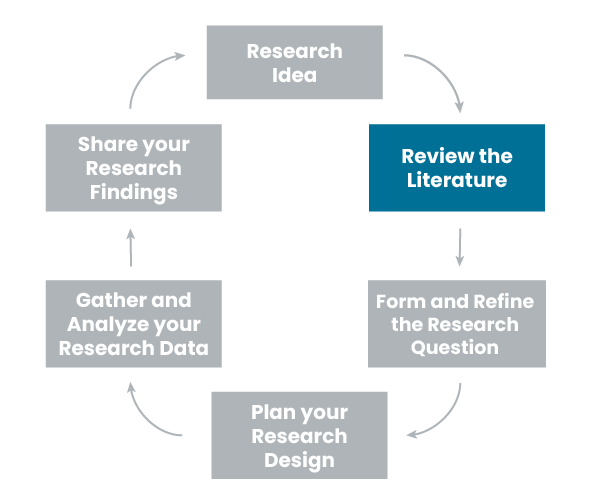
Generating a review of the literature for your research proposal
The purpose of a traditional literature review is to gain a comprehensive understanding of the current state of knowledge on a given topic. It helps identify gaps in existing research, provides context for your own study, and familiarizes you with key scholarly contributions in the field. Typically initiated during the early stages of research idea development, the literature review is an ongoing process that continues throughout the research journey. It informs the formulation of the research question, guides methodological choices and analysis, supports the interpretation of findings, and contributes to the translation of knowledge. The process begins with a broad review of the literature to explore existing knowledge and identify areas that require further investigation. This foundational review helps shape a focused research question. Once the question is established, the review becomes more targeted, concentrating on specific aspects of the literature that directly relate to the study’s objectives.
Explore current state of knowledge
Identify gaps in literature
Formulate a research question to address these gaps
Refine study design and methods
Focus on studies directly related to the research question to interpret findings
The process of reviewing the literature
Search for relevant literature:
- Presentation: The process of searching the literature for research by Jo-Anne Petropoulos, HHS McMaster Site Librarian, Research Knowledge and Skill Builder [Video | Slides]
- McMaster resource: Searching the Literature: The Basics – McMaster Health Sciences Library
Select and organize the literature:
Write the literature review:
- External resource: How to Write a Literature Review – Concordia University
EDI Considerations
Use diverse key words to gain broader knowledge of who is impacted by the research or who contributes to the research, but might not be included.
Questions to consider: Are certain diversity factors and/or intersections known to affect the phenomenon of interest? What are the relevant knowledge gaps? Have previous studies failed to incorporate relevant diversity factors or omitted investigating their intersections adequately?
Visit the Equity and Engagement in Research page for more details.
Critically appraising the literature
Critical appraisal is a crucial process that enables researchers, clinicians, and students to assess the validity, relevance, and reliability of published studies. This process involves systematically examining research articles to assess their methodological rigour, the credibility of their findings, and their applicability to specific contexts or populations. By engaging in critical appraisal, one can distinguish high-quality evidence from studies with potential biases or limitations, thereby fostering informed decision-making and advancing knowledge within a discipline. It also encourages a reflective and analytical mindset, promoting deeper understanding and responsible use of scientific evidence.
- Presentation: Critically Appraising Literature by Jennifer Lawson – Research Knowledge and Skill Builder [Video]
- Journal Article: Majid, U. & Vanstone, M. (2018). Appraising qualitative research for evidence syntheses: a compendium of quality appraisal tools. Qualitative health research, 28(13), 2115-2131.*
Formal critical appraisal checklists are also available and provide structured frameworks for evaluating the quality and trustworthiness of research studies. These tools guide users through key aspects of study design, methodology, results, and relevance, helping ensure that conclusions drawn from the literature are based on sound evidence and rigorous analysis.
- Checklists: CASP Checklists – Public Health Resource Unit, NHS, England
- CASP Checklists are a set of eight critical appraisal tools designed to be used when reading research. They are designed for use with Systematic Reviews, Randomized Controlled Trials, Cohort Studies, Case-Control Studies, Economic Evaluations, Diagnostic Studies, Qualitative studies, and Clinical Prediction Rule.
Literature Reviews as Research Method
Literature reviews can be used in a structured and comprehensive way to gather, evaluate, and integrate findings from multiple studies to answer a specific research question or inform practice. When conducted for evidence synthesis, it uses structured methods to critically appraise and combine findings from multiple studies, ensuring transparency and reliability. In contrast, narrative reviews offer a more flexible, descriptive approach, highlighting themes and expert perspectives. Together, these methods provide both analytical rigour and contextual depth to inform research, practice, and policy.
Deciding on the type of review
- Online tool: What Review is Right for You? – Dr. Andrea Tricco et al.
- This tool is designed to provide guidance and supporting material to reviewers on methods for the conduct and reporting of literature review.
- Journal article: Sutton, A., Clowes, M., Preston, L., & Booth, A. (2019). Meeting the review family: exploring review types and associated information retrieval requirements. Health Information & Libraries Journal, 36(3), 202-222.*
- Journal article: Ahmed, S., Vaska, M., & Turin, T. C. (2016). Conducting a literature review in health research: basics of the approach, typology and methodology. J Natl Heart Found Bangladesh, 5, 44-51.
Common types of literature reviews
Literature reviews vary in scope and methodology depending on the purpose of the inquiry. Each type serves a distinct role in evidence synthesis, contributing to informed scholarship and practice.
Systematic reviews follow a rigorous, transparent process to answer specific research questions using predefined criteria.
Narrative reviews provide a broader, interpretive overview of a topic, often highlighting themes and expert insights.
Scoping reviews provide a structured approach to mapping the breadth, depth, and characteristics of research in emerging or complex areas.
Rapid reviews streamline the process for timely decision-making.
Additional Tools
- Tipsheet: How to access full text for research articles via McMaster Health Science Library
- Tutorials: Tools for effective database searching – Health Science Library
- YouTube video: How I read a paper!
- Guidelines: Enhancing the Quality and Transparency of Health Research – equator network
- Journal article: Lingard, L. Joining a conversation: the problem/gap/hook heuristic. Perspect Med Educ 4, 252–253 (2015).
*DFM faculty members can access full text articles from the McMaster Health Sciences Library using your MacID. To request your MacID, or if you’re having issues, please email Faculty Relations at fmappts@mcmaster.ca.
Connect with Us
For support, feedback, or to suggest a resource, email dfmresearch@mcmaster.ca