
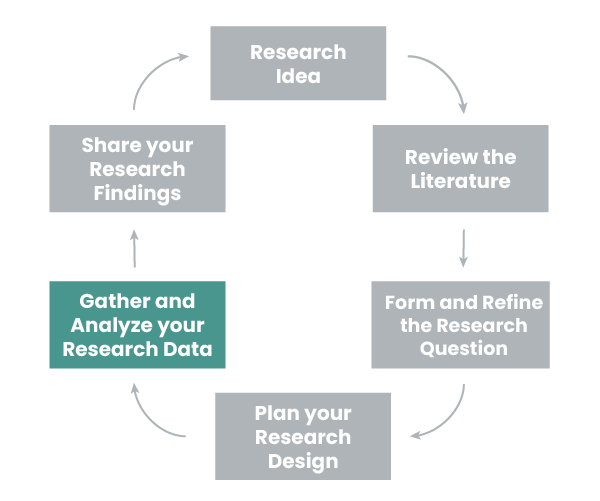
Gather and Analyze your Research Data
This section provides best practices for active organization, handling and maintenance of the data created throughout the research process. Data lifecycle goes from planning, collection, processing, data analysis and secure deletion.
Data Management
Before collecting any data, it’s critical to establish a Data Management strategy. Data management refers to the process of collecting, storing, organizing, and maintaining research data throughout a project’s lifecycle. It ensures that data is: accurate, consistent, secure, accessible and preserved for future use or sharing. In research, good data management practices help maintain integrity, reproducibility, and compliance with institutional and funding requirements.
A Data Management Plan is a formal document that outlines how data will be handled during and after a research project. It typically includes information on the types of data you will collect (e.g., surveys, interviews, lab results), file formats and organization, storage and backup procedures, access and sharing policies, and ethical and legal considerations (privacy, consent, confidentiality). Many funding agencies (e.g., CIHR, NIH) require a DMP as part of grant applications to ensure transparency and sustainability.
- Standard Operating Procedure: DFM Research Data Management SOP
- Template: DFM Data Management Plan
- Presentation: Data Management for Tri-Agency Grants by Rebecca Clark, Research Knowledge and Skill Builder [Slides | Video]
- Presentation: Managing your research data: an introduction to DMP Assistant by Jay Brodeur and Isaac Pratt, Research Knowledge and Skill Builder [Slides | Video]
- Examples: DMP exemplars
- Presentation: Frontend and Backend Database Development by Steve Dragos, Research Knowledge and Skill Builder [Video | Slides]
Designing Research Instruments for Data Collection
Research instruments are the tools used to collect data systematically and reliably. These can include surveys, questionnaires, interview guides, observation checklists, and standardized tests. Well-designed instruments ensure that the data you gather is valid, reliable, and aligned with your research objectives.
Define Research Objectives
Choose the appropriate instrument type: Qualitative or Quantitative
Ensure Validity and Reliability of the Instrument (if applicable)
Pilot test for clarity and accessibility
Document the process
Designing a research instrument
- Tip Sheet: How to develop a focus group and interview guide
- Journal article: Kallio, H., Pietilä, A. M., Johnson, M., & Kangasniemi, M. (2016). Systematic methodological review: developing a framework for a qualitative semi‐structured interview guide. Journal of advanced nursing, 72(12), 2954-2965.*
- Presentation: Designing and administering surveys by Dr. Michelle Howard
- Journal article: Artino Jr, A. R., La Rochelle, J. S., Dezee, K. J., & Gehlbach, H. (2014). Developing questionnaires for educational research: AMEE Guide No. 87. Medical teacher, 36(6), 463-474.
- Journal article: Rickards, G., Magee, C., & Artino Jr, A. R. (2012). You can’t fix by analysis what you’ve spoiled by design: developing survey instruments and collecting validity evidence. Journal of graduate medical education, 4(4), 407-410.
- Presentation: Validating tools – Dr. Matt Kwan and Jeffrey Graham, Research Knowledge and Skill Builder [Video | Slides]
Piloting a research instrument
- Tip sheet: Piloting surveys
- Webpage: How to pretest and pilot a survey questionnaire – tools4dev
- Tip sheet: Piloting the question guide – for interview and focus groups
Data Collection
Data collection in primary care involves gathering clinical, administrative, and patient-reported data in ways that are feasible within routine practice.
Gathering data directly from the participant
- Presentation: REDCap – Dr. Ric Angeles and Steve Dragos, Research Knowledge and Skill Builder [Video part 1 | Video part 2; Slides part 1 | Slides part 2]
- Presentation: LimeSurvey – Michael Wilson, Research Knowledge and Skill Builder [Video]
- Presentation: Interviews and Focus Groups – Jessica Jurgurtis, Research Knowledge and Skill Builder [Slides]
- Journal article: McGrath, C., Palmgren, P. J., & Liljedahl, M. (2019). Twelve tips for conducting qualitative research interviews. Medical teacher, 41(9), 1002-1006.
- Presentation: Responding to Sensitive Health & Social Issues in Research Interviews by Laura Cleghorn & Jessica Gaber [Slides]
- Tip sheet: Virtual interview and focus groups
- Tip sheet: How to use DFM transcription service
- Tip sheet: Automated Transcription Services
Other data sources include Medical records and administrative databases. Click below to explore these topics.
Data Collection at McMaster Family Health Team
Data Analysis
Research data analysis is the process of systematically examining, organizing, analyzing, and interpreting data to uncover meaningful patterns, relationships, and insights. It transforms raw information into evidence or new knowledge that can inform clinical practice, policy decisions, and equity-driven interventions.
In clinical research, data analysis helps answer critical questions about patient outcomes, treatment efficacy, and healthcare delivery. Quantitative critical questions may focus on the prevalence or patterns of a health condition or clinical practice (descriptive analysis), or on relationships between factors, such as the impact of a new care model on outcomes (inferential analysis). In contrast, qualitative critical questions explore the perspectives and experiences of patients, providers, or communities. Whether you’re working with quantitative data from surveys and electronic health records or qualitative data from interviews and focus groups, the goal is the same: to make sense of complexity and generate actionable knowledge to improve patient outcomes and healthcare delivery.
For mixed methods research, analysis becomes even more dynamic. It involves integrating statistical rigour with narrative depth, i.e. quantitative findings might reveal trends, while qualitative insights explain the “why” behind those trends. This approach is compelling in community-based research, where understanding lived experiences is just as vital as measuring disparities.
Quantitative Data Analysis
Descriptive Analysis
As part of the analysis, investigators should first describe their study sample or patient population. Descriptive analysis involves descriptive statistics, which are numbers that summarize data with the purpose of describing the study sample or patient population. Frequency distribution, mean, median, mode, range, and standard deviation are the most used statistics. Characteristics of the study sample or patient population that are important to describe are commonly demographic (e.g., age), clinical (e.g., health conditions), and geographic (e.g., rural/urban) patterns. Descriptive analysis summarizes data that would be useful information for a specific topic area and/or program planning, since it constitutes describing the study sample or patient population.
- Presentation: Data visualization in research by Subhanya Sivajothi, Research Knowledge and Skill Builder [Slides | Video | Libguide]
- Presentation: SPSS – Dr. Larkin Lamarche and Melissa Pirrie, Research Knowledge and Skill Builder [Video part 1 | Slides 1| Slides 2]
- Presentation: Just the basics: Learning about the essential steps to do some simple things in SPSS by Dr. Larkin Lamarche, Research Knowledge and Skill Builder [Video | Slides]
Inferential Analysis of Quantitative Data
Inferential analysis involves inferential statistics, which are based on probability theory and the logic of hypothesis testing. Because researchers rarely have access to an entire population, inferential statistics allow researchers to use a sample to draw inferences about the larger population of interest. Therefore, inferential statistics rely on appropriate sampling methods, adequate sample size, and adherence to statistical assumptions.
There are three basic categories of inferential analysis that differ based on their intended purpose, including: evaluating differences (e.g., t-tests), examining relationships (e.g., correlations), and making predictions (e.g., simple or multiple regression analysis). Researchers should keep in mind that the type of data determines the type of test (e.g., parametric vs. non-parametric).
Inferential analysis used in primary care research commonly answers questions about the effect of interventions or changes to clinical practices on patient outcomes, as opposed to research questions on the causes of a health condition or disease.
- Presentation: Choosing the appropriate statistical test by Dr. Larkin Lamarche [Summary | Slides | Video]
- Journal article: Shorten, A., & Shorten, B. (2015). Which statistical tests should I use? Evidence-based nursing, 18(1), 2-3.
- Online tool: Suner, A., Karakülah, G., Koşaner, Ö., & Dicle, O. (2015). StatXFinder: a web-based self-directed tool that provides appropriate statistical test selection for biomedical researchers in their scientific studies. SpringerPlus, 4(1), 1-13
- Example: Quantitative data analysis plan – Table (PDF)
Qualitative Data Analysis
Critical questions that are qualitative in nature can ask about the perspectives and experiences of patients, providers or community members.
- Learning module: Lacey, Anne and Luff, Donna. Trent Focus for Research and Development in Primary Health Care: An Introduction to Qualitative Analysis. Trent Focus, 2001
- Presentation: Data Coding and Analysis – Dr. Meredith Vanstone, Research Knowledge and Skill Builder
- Presentation: What to Know About NVivo: A Qualitative Primer – Jessica Gaber, Laura Cleghorn, Research Knowledge and Skill Builder [Part 1: Video | Slides; Part 2: Video | Slides]y
- Example: Qualitative data analysis plan– Table (PDF)
- Software: NVivo | Dedoose
Qualitative Description
Qualitative Description is a methodological approach, not just an analysis technique. It aims to provide a straightforward, low‑inference summary of participants’ experiences in everyday language. It focuses on what participants said rather than interpreting underlying meanings.
- Journal article: Sandelowski, M. (2000). Whatever happened to qualitative description? Research in nursing & health, 23(4), 334-340.
- Journal article: Sandelowski, M. (2010). What’s in a name? Qualitative description revisited. Research in nursing & health, 33(1), 77-84.
Thematic Analysis
It focuses on identifying and interpreting patterns of meaning (themes) across data. It aims to understand underlying meanings, experiences, and concepts. It is commonly used to explore how and why people perceive or experience something.
- Learning module: One-stop shop – Thematic Analysis, The University of Auckland
- Book: Saldaña, J. (2021). The coding manual for qualitative researchers. SAGE.
- Journal article: Braun, V., & Clarke, V. (2019). Reflecting on reflexive thematic analysis. Qualitative Research in Sport, Exercise and Health, 11(4), 589-597.*
Content Analysis
It focuses on systematically categorizing elements of data (e.g., words, concepts, codes). It is more structured and descriptive, often used to examine what is present in the data and how often.
- Journal article: Hsieh, H.F. and Shannon, S.E., 2005. Three approaches to qualitative content analysis. Qualitative health research, 15(9), pp.1277-1288.*
- Journal article: Assarroudi, A., Heshmati Nabavi, F., Armat, M. R., Ebadi, A., & Vaismoradi, M. (2018). Directed qualitative content analysis: the description and elaboration of its underpinning methods and data analysis process. Journal of Research in Nursing, 23(1), 42-55.*
*DFM faculty members can access full text articles from the McMaster Health Sciences Library using your MacID. To request your MacID, or if you’re having issues, please email Faculty Relations at fmappts@mcmaster.ca.
Connect with Us
For support, feedback, or to suggest a resource, email dfmresearch@mcmaster.ca