
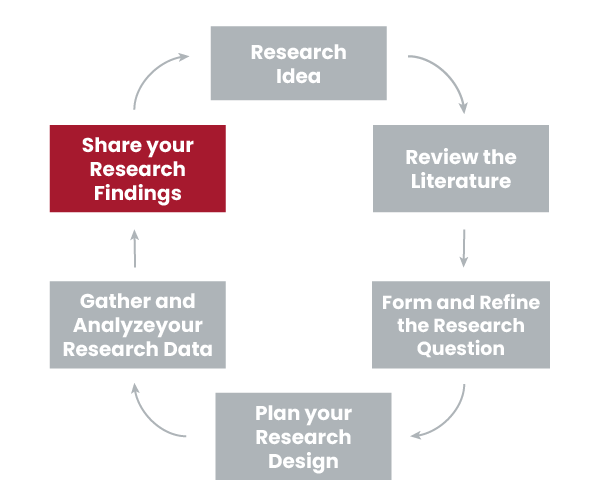
Share your Research Findings
This page brings together guidance and resources that support knowledge translation (KT) and the sharing of research findings, from early planning through to dissemination and evaluation of impact.
Knowledge translation is an ongoing process that includes planning, working with knowledge users, developing clear messages, and sharing findings through appropriate academic, professional, and public channels. Whether you are preparing a grant, working with partners, developing research outputs, or deciding how best to share completed findings, this page is designed to support you at different stages of the research process.
Knowledge translation
Knowledge translation (KT) is an active process that includes the synthesis, dissemination, exchange and implementation of knowledge. KT aims to bridge the gap between knowledge producers and knowledge users with the goal of improving health, providing more effective health services, and strengthening the healthcare system. KT is not a single activity that happens at the end of a project. Instead, it can occur at multiple points across the research lifecycle, from shaping research questions to sharing findings and evaluating their impact.
Integrated and end‑of‑grant knowledge translation
KT can take different forms depending on the nature and goals of a project. Both approaches are valuable and often complementary. Many projects include a combination of integrated and end‑of‑grant KT activities.
- End-of-grant KT refers to activities that take place once study findings are available, including journal publications, conference presentations, infographics, research briefs, public-facing commentaries or media pieces.
- Integrated KT involves collaboration with knowledge users throughout the research process. Knowledge users may include clinicians, patients, caregivers, policymakers, community partners, and others who may use the research. IKT activities may include co-identifying priorities, co-developing research questions, co-interpreting findings, co-creating outputs, ongoing communication during and after the project.
Planning knowledge translation activities
Effective knowledge translation is most successful when it is planned early and aligned with the goals and context of a research project. Thoughtful planning helps ensure that KT activities are feasible, relevant, and responsive to the needs of intended audiences. When planning KT activities, researchers are encouraged to consider:
- Goals: What change do you hope to support with your research?
- Audiences: Who might use, influence, or benefit from your findings?
- Strategies: Which KT approaches or outputs are best suited to these audiences and goals?
- Timing: When should KT activities take place across the project lifecycle?
- Feasibility: What resources, skills, relationships, or supports are needed?
The following resources introduce core KT concepts and provide practical guidance for planning KT activities, including both integrated and end‑of‑grant approaches:
- Presentation: Knowledge Translation Planning by Advina Kamaric and Casey Irvin, Research Knowledge & Skill Builder [Video | Slides]
- Presentation: Knowledge Translation Parts I & II by Erin Beaulieu and Casey Irvin, Research Knowledge & Skill Builder [Part 1: Video | Slides; Part 2: Video | Slides]
- Presentation: Integrated knowledge translation with a health system partner by Dr. Melissa Pirrie [Slides | Video]
- External resource: Guide to Knowledge Translation Planning at CIHR: Integrated and End-of-Grant Approaches – CIHR
- External resource: A Guide to Researcher and Knowledge-User Collaboration in Health Research – CIHR
- External resource: Knowledge Translation Planning Template – Hospital for Sick Children, Toronto
- Learning modules: Knowledge Translation – SickKids Academy Online
Theories, models and frameworks
Theories, models, and frameworks can guide KT planning, implementation, and evaluation. They help clarify assumptions, identify potential barriers, and support the design of KT strategies. One commonly used framework in health research is the Knowledge‑to‑Action (K2A) framework, which provides a practical structure for moving research evidence into practice by linking knowledge creation with action and implementation.
- External resource: How to Choose a KT Theory, Model or Framework – Centre for Healthcare Innovation, University of Manitoba
- Presentation: Knowledge to Action Cycle: In Action by Claire Bodkin, Erin Beaulieu, Fiona Kouyoumdjian, Marina Sadik – Large Research Group Meeting [Video | Slides]
- External resource: Knowledge-to-Action (Knowledge Translation in Health Care: Moving from Evidence to Practice, Section 3, CIHR)
- Journal article: Straus, S. E., Tetroe, J., & Graham, I. (2009). Defining knowledge translation. Canadian Medical Association Journal, 181(3–4), 165–168.
Identifying and shaping key messages
Clear, focused key messages help ensure research findings are understood and used. This section provides guidance on distilling complex findings into concise, meaningful messages and applying plain‑language principles across different types of research outputs.
- Presentation: And, But, Therefore: Key Message Development – Meerab Majeed, Research Huddle
- Journal article: Lingard, L. Joining a conversation: the problem/gap/hook heuristic. Perspect Med Educ 4, 252–253 (2015).
- External Resource: Plain language is for everyone, even experts – Nielsen Norman Group
- External Resource: Plain Language Writing Checklist – The Hospital for Sick Children
- External Resource: Plain language thesaurus – ICES
Preparing and sharing research outputs
Support for preparing, and publishing research in peer‑reviewed journals, including writing, reporting guidelines, open access, and journal selection.
Guidance on sharing research with non‑academic audiences, including public‑facing publishing, media, digital platforms, and research repositories.
Designing effective visual research outputs
Visual research outputs such as posters, infographics, and slide decks can support understanding and uptake of research findings. This section includes resources to support the design of clear, engaging visual materials for academic and non‑academic contexts. DFM faculty and staff may contact the KT team (dfmcomms@mcmaster.ca) for access to templates and design support.
- Presentation: How to Create A Better Poster
- Presentation: Presenting Data in Visually Engaging Ways – Casey Irvin, Research Knowledge and Skill Builder [Video | Slides]
- Presentation: Data visualization in research by Subhanya Sivajothi, Research Knowledge and Skill Builder [Slides | Video | Libguide]
- Presentation: Effective Infographics in Health Communication
- Tip Sheet: Infographic Planning
- External Resource: Strategies for Clear and Engaging Slides (Harvard T.H. Chan School of Public Health)
Impact and evaluation
Evaluating knowledge translation
Evaluating knowledge translation activities can help demonstrate the reach, influence, and use of research, support reporting requirements, and inform future dissemination efforts.
- External Resource: Knowledge Translation Evaluation Planning Guide – Alberta Health Services
- External Resource: How to Measure the Impact of KT – JSI
Researcher profiles and research impact
Researcher profiles and discovery platforms support attribution of scholarly work, improve the visibility of research outputs, and promote collaboration. These tools can be used across research activities, not only academic publishing.
- McMaster Resource: Researcher’s Toolkit: Write & Publish – Health Sciences Library
- Guidance on using ORCID to link publications and research outputs to a persistent researcher identifier.
- McMaster Resource: McMaster Experts
- A research discovery platform that presents McMaster faculty research activities, including affiliations, areas of expertise, research interests, and research outputs. McMaster Experts also maps relationships between researchers to highlight existing collaborations and support future connections.
*DFM faculty members can access full text articles from the McMaster Health Sciences Library using your MacID. To request your MacID, or if you’re having issues, please email Faculty Relations at fmappts@mcmaster.ca.
Connect with Us
For support, feedback, or to suggest a resource, email dfmresearch@mcmaster.ca