
Form and Refine the Research Question
A well-developed research question is the foundation of a successful study because it shapes the entire study structure. For example, a strong research question leads to appropriate strategies for participant enrolment, data collection, and analysis. Therefore, the research question guides the entire research process, from design to analysis.
EDI Considerations
Developing a strong research question requires considering who may benefit from the research, who may be excluded, and whether the question reflects the experiences and needs of diverse populations. When refining your research question, consider whether the populations most affected by the issue are meaningfully represented; whether any socio-demographic factors are important to understanding the phenomenon being studied; and how the research could contribute to identifying, reducing, or preventing inequities. Researchers should also strive to use inclusive, respectful language and avoid assumptions, stereotypes, or stigmatizing terminology that may overlook strengths, resilience, and the broader structural factors influencing health and social outcomes.
Visit the Equity and Engagement in Research page for more details.
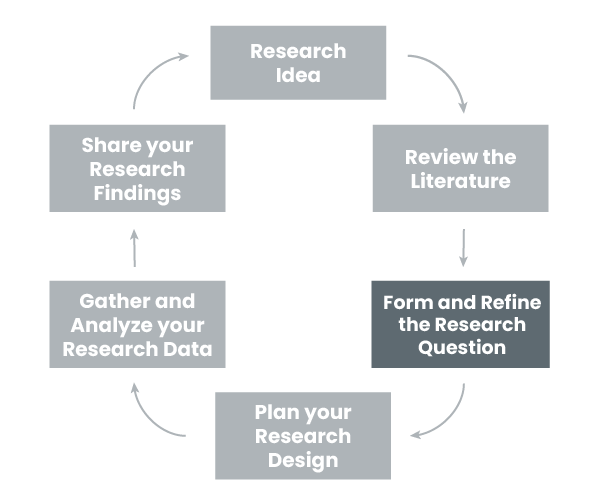
The Research Question
The research question guides the direction of your study and ensures that your study is focused, relevant, and capable of producing meaningful results. There are several ways to develop and frame the research question. Many of these approaches are based on easy-to-remember acronyms, with each letter representing a component of a well-structured research question. These components should come together to form your research question as a single, clear sentence.
Criteria to Consider when Developing your Research Question
The FINER criteria are used to define the attributes of a strong research question, including its practicality. FINER stands for Feasibility Interesting Novel Ethical Relevant.
Framing Research Questions for Quantitative Research
The PICO format specifies four components to a well-structured research question: Patient/Population/Problem, Intervention, Comparison, and Outcome. It has also been expanded to include a fifth component, Timeframe (e.g., PICOT), which specifies the period over which outcomes will be assessed. It is commonly used to frame research questions for intervention-based comparative studies.
Framing Research Questions for Qualitative Research
There are several acronyms used to guide the development of well-structured qualitative research questions. PS, PiCo, and SPIDER are commonly recommended for constructing questions that support literature searches of existing qualitative evidence. In contrast, the EPPiC framework—developed by McMaster University—helps researchers formulate clear and focused research questions for original qualitative studies. The acronyms stand for the following:
PS: Population/Problem, and Situation
PiCo: Population, Phenomena of Interest, and Context
SPIDER: Sample, Phenomenon of Interest, Design, Evaluation, and Research type
EPPiC: Emphasis, Purpose, Phenomenon of Interest, and Context
For more information, review the following resources:
- Journal Article: Thabane, L., Thomas, T., Ye, C., & Paul, J. (2009). Posing the research question: not so simple. Canadian Journal of Anesthesia/Journal canadien d’anesthésie, 56(1), 71-79.
- Journal Article: Covvey, J. R., McClendon, C., & Gionfriddo, M. R. (2024). Back to the basics: Guidance for formulating good research questions. Research in Social and Administrative Pharmacy, 20(1), 66–69.
- Journal Article: Ratan SK, Anand T, Ratan J. Formulation of Research Question – Stepwise Approach. J Indian Assoc Pediatr Surg. 2019 Jan-Mar;24(1):15-20.
- Journal Article: Barroga E, Matanguihan GJ. A Practical Guide to Writing Quantitative and Qualitative Research Questions and Hypotheses in Scholarly Articles. J Korean Med Sci. 2022 Apr 25;37(16):e121
- McMaster Resource: Forming Questions – Health Science Library
- Video: Formulating Research Questions – McMaster Program for Faculty Development
- External Resource: Formulating Research questions – Fraser Health Research Toolkit
*DFM faculty members can access full text articles from the McMaster Health Sciences Library using your MacID. To request your MacID, or if you’re having issues, please email Faculty Relations at fmappts@mcmaster.ca.
Connect with Us
For support, feedback, or to suggest a resource, email dfmresearch@mcmaster.ca