
Form and Refine the Research Question
A well-crafted research question is the foundation of a successful research study. A research question guides the entire research process, from design to analysis. The research design dictates how you’ll gather and analyze data to answer that question, shaping the study’s structure and methods.
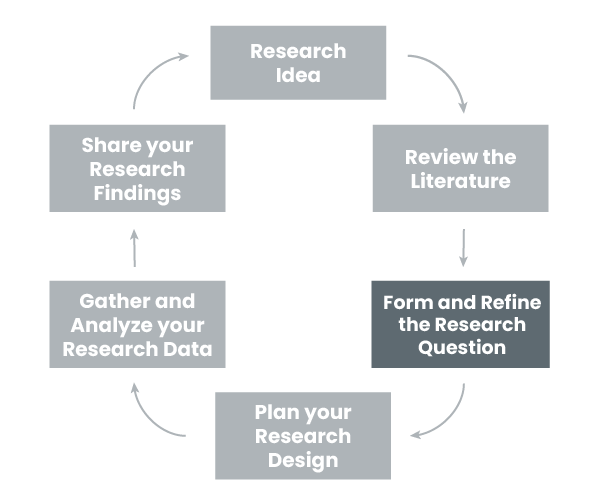
The Research Question
A strong question not only guides the direction of your investigation but also ensures that your study is focused, relevant, and feasible. Different frameworks exist to help researchers craft focused, feasible, and methodologically aligned questions.
General Research Question Development
FINER stands for Feasibility Interesting Novel Ethical Relevant. This framework is used to evaluate the strength and practicality of a research question.
Frameworks for Quantitative Research
PICO stands for Patient/Problem Intervention Comparison Outcome. It can help structure questions for intervention-based studies.
PICOT adds Timeframe to the above framework. It is useful in clinical trials, prognosis or follow-up studies.
Frameworks for Qualitative Research
PICo stands for Population Interest (phenomenon) Context. It works best for qualitative research with a clearly defined population or context.
SPIDER stands for Sample Phenomenon of Interest Design Evaluation Research type. This framework is helpful for qualitative evidence synthesis or mixed-methods review.
For more information, review the following resources:
- Journal Article: Covvey, J. R., McClendon, C., & Gionfriddo, M. R. (2024). Back to the basics: Guidance for formulating good research questions. Research in Social and Administrative Pharmacy, 20(1), 66–69.
- Journal Article: Ratan SK, Anand T, Ratan J. Formulation of Research Question – Stepwise Approach. J Indian Assoc Pediatr Surg. 2019 Jan-Mar;24(1):15-20.
- Journal Article: Barroga E, Matanguihan GJ. A Practical Guide to Writing Quantitative and Qualitative Research Questions and Hypotheses in Scholarly Articles. J Korean Med Sci. 2022 Apr 25;37(16):e121
- McMaster Resource: Forming Questions – Health Science Library
- Video: Formulating Research Questions – McMaster Program for Faculty Development
- External Resource: Formulating Research questions – Fraser Health Research Toolkit
*DFM faculty members can access full text articles from the McMaster Health Sciences Library using your MacID. To request your MacID, or if you’re having issues, please email Faculty Relations at fmappts@mcmaster.ca.
Connect with Us
For support, feedback, or to suggest a resource, email pcrc@mcmaster.ca